
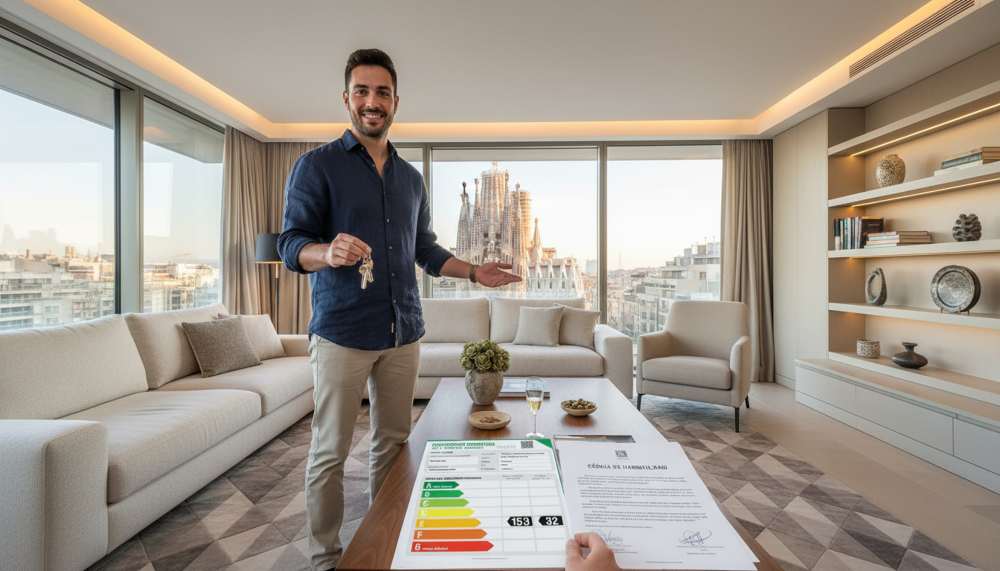
Introduction to the energy performance certificate in Barcelona and its importance when selling a property
In the Barcelona property market, one of the essential requirements for selling a dwelling is to have the Barcelona energy performance certificate. This document has become a key tool in guaranteeing the energy efficiency of properties, in line with current regulations and promoting sustainability.
Certification not only provides legal certainty during the transaction, but also influences the perceived value of the property in the eyes of buyers, who are increasingly aware of environmental impact and energy savings.
What is the energy performance certificate and why is it mandatory in Barcelona?
The energy performance certificate, regulated by Royal Decree 235/2013 and adapted to Catalan regional regulations, assesses a dwelling’s energy consumption and its level of CO2 emissions. In Barcelona, it is a legal requirement for selling or letting properties, in accordance with European Directive 2010/31/EU, which promotes energy efficiency in buildings.
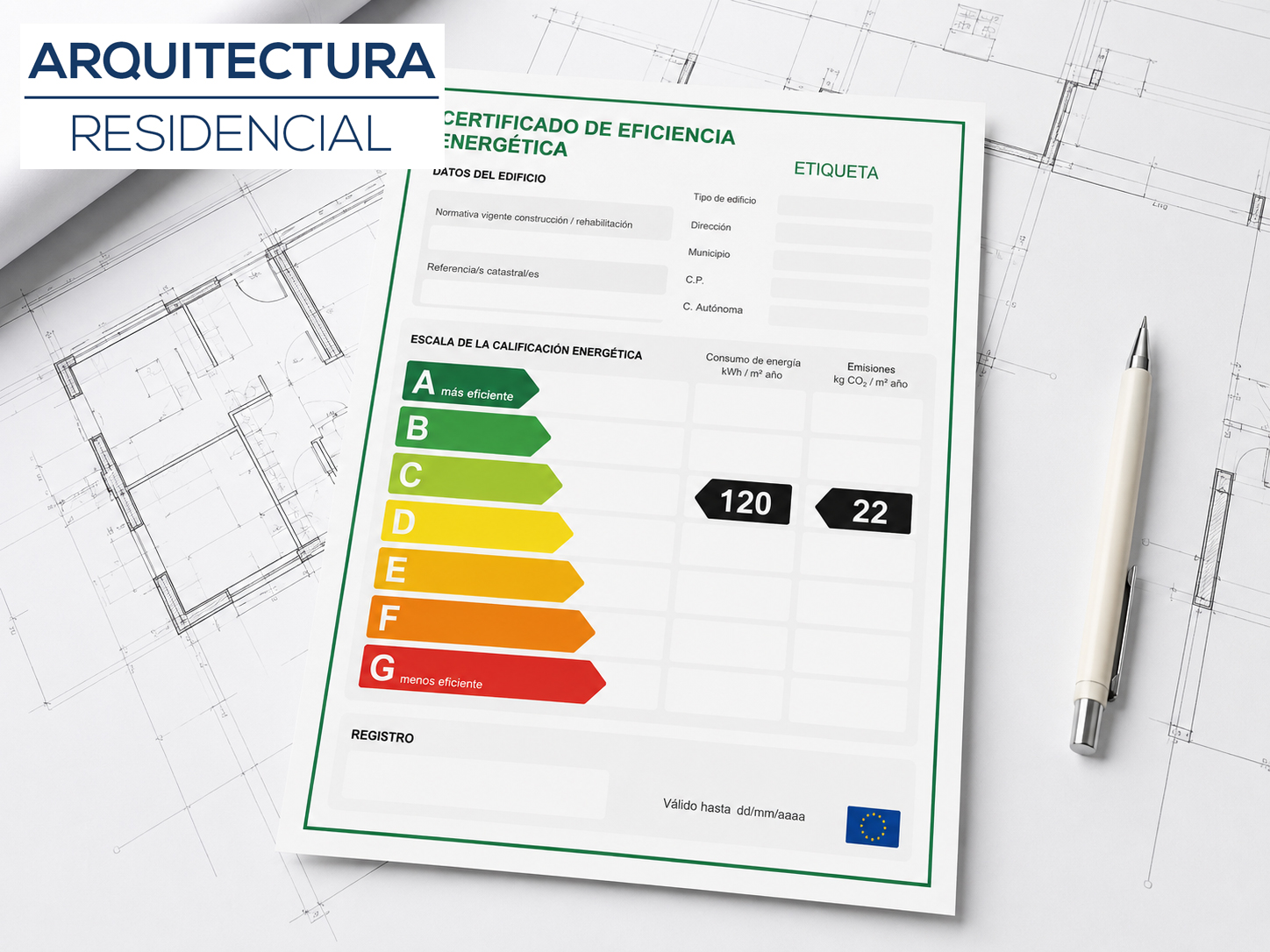
This certificate assigns a rating from A (most efficient) to G (least efficient), helping buyers and users understand the property’s performance and estimate future energy expenditure.
Components of the energy performance certificate
- General property details: location, construction characteristics and floor area.
- Energy assessment: analysis of insulation, thermal installations, ventilation, lighting and other elements.
- Energy label: visual classification of performance.
- Recommendations: improvements to optimise efficiency and reduce costs.
When is the energy performance certificate mandatory?
- Sale and letting: Energy performance certificates must be obtained in order to be made available to buyers or users of flats, commercial premises, offices and buildings when they are sold or let.
- Estate agencies: A specific obligation is established for estate agencies to display the energy performance certificate of properties in their portfolio for sale or letting.
- Phases depending on the type of building:
- For new buildings or extensions, certification consists of two phases: “energy performance certification at project stage” and “energy performance certification upon completion of works”.
- For existing buildings, the process consists of a single phase known as “energy performance certification of an existing building”.
- Buildings with a usable floor area exceeding 500 m² intended for specific uses (administrative, healthcare, commercial, public residential, educational, cultural, etc.).
- Buildings occupied by a public authority with a floor area exceeding 250 m².
- Buildings required to undergo the Building Technical Inspection (ITE) or an equivalent inspection.
- Exemptions: If an owner wishes to rely on one of the exemptions permitted by law, they must submit a responsible declaration to the competent authority of their autonomous community.
- Refurbishments or extensions: Certification became mandatory for refurbishments involving the renewal of thermal installations requiring a project, or interventions affecting more than 25% of the thermal envelope.
Order ECM/599/2025, of 10 June, amends Order ECO/805/2003 to update property valuation standards, primarily incorporating criteria relating to sustainability and energy efficiency for financial purposes, such as mortgage guarantees.The most significant new feature is that the Energy Performance Certificate becomes a mandatory documentary requirement in order to carry out a mortgage valuation. The aim of this measure is to ensure that the valuer has key information on energy demand and construction characteristics in order to assess the impact of energy performance on the market value of the property.
Detailed process for obtaining the energy performance certificate in Barcelona
Obtaining the energy performance certificate is a technical and regulatory process that must be carried out by qualified professionals, such as architects or engineers. The steps for processing it correctly are described below:
1. Selection of a qualified certifying technician
Catalan regulations require the certificate to be issued by a recognised and accredited professional. At Arquitectura Residencial, we recommend choosing experts in energy certification who will issue a report on the current condition of the property and proposed improvements to increase energy efficiency. There is a Central Administrative Register of Qualified Technicians, managed by the Ministry for Ecological Transition, where the details of accredited technicians can be consulted. Accredited professionals include Architects, Technical Architects, Building Surveyors and Building Engineers, Industrial Engineers, among others. The list of technicians can be consulted at the ICAEN.
2. Inspection and data collection at the property
The technician visits the flat to examine key aspects such as the heating and air-conditioning systems, the condition of thermal insulation, orientation, windows and lighting network. This inspection is essential for an accurate diagnosis in accordance with the General Procedure regulated by the Institut Català d’Energia (ICAEN).
3. Energy calculation and analysis
Following the inspection, recognised software tools are used to calculate the flat’s energy demand and associated emissions. Based on these results, the corresponding energy label is awarded. In addition, the technician issues a report containing technically viable recommendations for improvement, including estimated payback periods and improvements in comfort and health.
4. Registration of the certificate
Finally, the energy performance certificate must be registered with the INSTITUT CATALÀ DE L’ENERGIA Register of Energy Performance Certificates of Buildings of Catalonia, a mandatory step that ensures its legal validity and allows verification of the information by buyers and estate agents.
Documentation required to apply for the energy performance certificate
To facilitate the technician’s work and reduce the time required for issuance, the owner must provide key documentation:
- Title deed or cadastral reference of the property.
- Floor plan of the flat or building, if available.
- Technical specifications of the building or dwelling.
- Details of heating, cooling and domestic hot water systems.
- Information on refurbishments carried out that affect energy efficiency.
Duration, validity and renewal of the energy performance certificate in Barcelona
The energy performance certificate has an official validity of 10 years from the date of issue. However, it is advisable to renew it if significant refurbishments are carried out that may improve the dwelling’s efficiency, such as replacing windows, improving insulation or upgrading heating systems. According to the latest amendment to the Law by Royal Decree 390/2021, where the certificate shows a G rating, its validity is reduced to five years.
- Reduced validity: While the general maximum validity of an energy performance certificate is ten years, where the building obtains a G rating, its maximum validity is reduced to five years.
- Responsibility for renewal: Once this five-year period has elapsed, the building owner is responsible for renewing or updating the certificate.
- Purpose: This measure aims to encourage improvements in the least efficient buildings, as the owner is required to review the rating more frequently if no improvements are made to raise the label.
It is essential to provide the updated energy performance certificate to the buyer at the time of sale. Failure to do so may result in administrative penalties and legal difficulties that could affect the transaction.
Factors influencing the energy performance certificate and its impact on the sale
In Barcelona, various factors may determine the energy rating obtained, thereby influencing the perception of the property in the market and its value:
Construction characteristics
Elements such as walls, roofs, external joinery and insulation directly affect energy consumption. Older dwellings without energy upgrades tend to obtain lower ratings, which may lead to a reduction in the asking price.
Installations and thermal systems
The efficiency of the boiler, air-conditioning system and use of renewable energy sources are viewed positively. Incorporating sustainable technologies can improve the rating and attract buyers interested in long-term savings.
Location and orientation
The urban microclimate, solar orientation and surroundings also influence the energy assessment, as solar exposure and external temperature affect thermal demand. For this reason, flats within the same building, even with the same layout, may receive different ratings.
Practical advice for preparing an optimised energy performance certificate before selling
- Carry out a preliminary analysis of the property: identify critical points affecting energy efficiency.
- Undertake minor improvements: such as enhancing insulation or installing double glazing.
- Upgrade installations: replace outdated systems with certified efficient equipment.
- Organise documentation: provide the technician with all required information to streamline the process.
- Avoid delays: obtain the certificate in advance to prepare the documentation for the sale.
Personal experience in managing the energy performance certificate in Barcelona
As professionals with more than three generations dedicated to the Barcelona property market, at Arquitectura Residencial we have managed hundreds of energy performance certificates for our vendor clients. Our experience confirms that anticipating this process is essential to avoid delays in the sale. We have found that advising owners on technical improvements that optimise the rating not only ensures legal compliance but also differentiates their flat in the market, attracting a broader buyer profile and achieving better financial terms.
Legal aspects and recommendations for protecting the seller
From a legal perspective, providing the Barcelona energy performance certificate is a statutory obligation arising from Law 8/2013 on urban rehabilitation, regeneration and renewal in Catalonia. Breach of this obligation may result in fines ranging from 300 to 6,000 euros, depending on the case.
Furthermore, an energy performance certificate with a low rating must be accompanied by transparent information in order to avoid subsequent claims for latent defects. Arquitectura Residencial always advises its clients to complete all necessary documentation and safeguard their interests during negotiations.
Approximate costs and timeframe for obtaining the energy performance certificate
The cost of certifying a flat in Barcelona varies according to size, complexity and the professional engaged, typically ranging between 150 and 400 euros. The procedure is usually completed within one week once the data collection has been carried out. Official registration generally takes no more than three days.
At Arquitectura Residencial, we offer certification at special rates for our clients. It is important to factor these costs into the sales process in order to plan properly and avoid unexpected issues.
FAQ – Frequently asked questions about the energy performance certificate for selling a flat in Barcelona
Having the Barcelona energy performance certificate is an essential and strategic step for any owner wishing to sell a flat in the city. More than a mere legal requirement, this document provides transparency, security and added value to the sales process. At Arquitectura Residencial, we advise and support our clients at every stage to optimise certification and maximise the appeal of their property to demanding and conscientious buyers.
Planning the certificate in advance, carrying out minor technical improvements and relying on professionals with local experience are key factors in achieving a secure and efficient sale.
Do you want to sell your flat in Barcelona with full guarantees?
Request a professional valuation from us and we will assist you with the energy performance certificate and the entire sales process.
Official references: You may consult the regulations and register at the Institut Català d’Energia (ICAEN), the legislation of the Official State Gazette (BOE) and the Spanish Association for Standardisation and Certification (AENOR).
Discover more from Your trusted real estate agency in Barcelona
Subscribe to get the latest posts sent to your email.



Join The Discussion